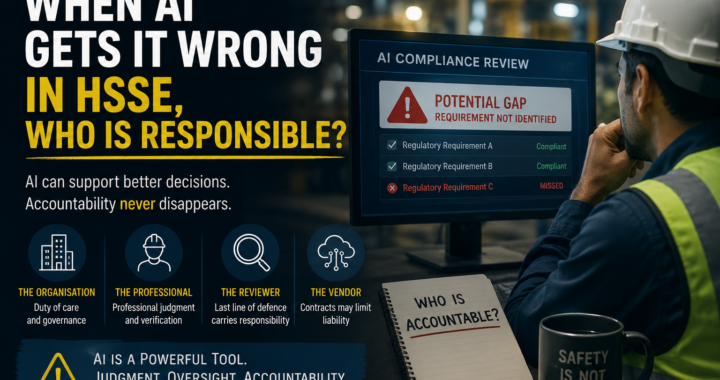
Something will go wrong. That is not a prediction — it is a certainty. The question the profession needs to answer now, before it happens, is who will be held accountable.
Many significant technologies that have entered high-risk industries have eventually been involved in serious incidents. Not because the technology was inherently dangerous, but because it was adopted faster than the frameworks for managing it — the oversight structures, competency requirements, liability frameworks, and professional standards — could keep pace.
AI in HSSE is following exactly that pattern. The tools are being adopted. The frameworks are not keeping up. And in an industry where getting it wrong means someone does not go home, that gap is not merely a compliance issue. It is a life safety issue.
The Scenario Nobody Wants to Talk About
Imagine this. A multinational contractor operating across three GCC countries uses an AI-assisted compliance platform to manage its legal register. The platform identifies applicable regulatory requirements, flags gaps, and generates recommended corrective actions. The HSSE team — stretched across multiple sites and managing hundreds of obligations — relies on it heavily.
The platform misses a requirement. Or misinterprets one. Or correctly identifies it but recommends an action that is subtly wrong in a way that looks right to a reviewer moving quickly. A control fails. There is a serious injury, a fatality, or a major environmental incident.
The investigation begins. The regulator asks how the control gap was not identified. The lawyer asks who signed off on the compliance assessment. The board asks what oversight was in place.
“The AI tool did not flag it” is not an answer that will satisfy any of those questions. But it is the answer that a surprising number of organisations are implicitly relying on right now.
Four Places Accountability Lands
When AI-assisted HSSE practice contributes to a harmful outcome, accountability does not disappear. It redistributes. Understanding where it goes is one of the most important things practitioners and organisations need to work through.
The AI vendor
The AI vendor may be contractually protected, at least initially. Current AI tool contracts are commonly written to disclaim liability for outputs used in professional or operational decisions. Whether those disclaimers would survive a serious legal challenge after a fatality or major environmental incident remains largely untested. But even if they are challenged, that process would be expensive, slow, and of little comfort to the people and organisations already exposed.
The professional who relied on the output
The professional who relied on the output without adequate verification carries significant personal and professional exposure. “The tool told me” has never been an acceptable defence in HSSE practice, and it will not become one because the tool is an AI. A qualified professional’s signature on a compliance assessment, a risk register, or a permit carries the same weight it always has. The source of the underlying analysis does not change that.
The organisation that deployed the tool
The organisation that deployed the AI without appropriate governance has created a systemic liability. Management of change processes exist precisely to assess new risks introduced by new ways of working. An AI tool embedded in compliance workflows is a significant change. If it was not assessed, documented, and governed as one, that is a finding waiting to be made.
The expert reviewer
The expert engaged to review AI outputs — and this is a role that is emerging rapidly as AI becomes embedded in HSSE practice — carries the accountability of the reviewer. Signing off on an AI-generated assessment is not a lighter responsibility than producing the assessment yourself. In some respects it is a heavier one, because the reviewer is the last line of defence before action is taken.
The Law Does Not Care What Tool You Used
This is the point that organisations adopting AI in HSSE functions need to understand clearly, and that many are currently glossing over.
Labour law, occupational safety obligations, environmental duties, and duty-of-care principles do not have an AI exemption. Across the jurisdictions in which multinationals operate — whether under GCC labour and occupational safety frameworks, the UK Health and Safety at Work etc. Act, or equivalent duty-of-care regimes elsewhere — the duty to protect workers, communities, and the environment does not disappear because a tool was used.
When a worker is seriously injured or killed, the investigation does not ask only what software was in use. It asks whether the organisation met its duty of care. It asks whether the responsible persons — the HSSE manager, site director, operations lead, or other accountable duty holders — took reasonably practicable steps to identify and control the risk.
An AI tool that missed a hazard, misread a regulation, or generated a plausible but incorrect control measure is not a simple mitigating factor in that analysis. It may become evidence that professional judgment was replaced by automated output without adequate oversight.
The same applies to professional liability. In jurisdictions where HSSE practitioners hold professional registrations, certifications, or chartered status, the standards of practice those credentials imply do not change because AI was part of the workflow. A certified or chartered safety professional who relies on an AI-generated risk assessment without critically evaluating it is not practising to the standard their qualification implies. If that assessment contains an error that contributes to a serious incident, the credential does not protect them. It may make the exposure worse, because it establishes that they should have known better.
The broad accountability principle is already clear. AI is a new tool operating inside an old accountability structure. Organisations and professionals who understand this will govern their use of AI accordingly. Those who assume that technology adoption transfers responsibility to the technology vendor are making a serious and potentially irreversible mistake.
The Judgment Problem
There is a deeper issue underneath the liability question, and it is one the profession needs to confront honestly.
AI does not exercise judgment. It identifies patterns, synthesises information, and generates outputs based on the information and instructions it has been given. In the best domain-specific tools, that underlying content may be rigorous, current, and carefully validated. In generic tools applied to HSSE problems, it frequently is not.
But judgment — the ability to read a specific site, a specific workforce, a specific regulatory environment, and a specific organisational culture, and to make a call that integrates all of those factors — is not something any current AI system can replicate.
It is also, candidly, not something every HSSE professional exercises well.
Years of experience do not automatically produce sound judgment. Professionals who have spent careers following checklists rather than developing genuine risk reasoning are not well positioned to critically evaluate AI outputs, because they have not developed the underlying capability that such evaluation requires.
This is the “you don’t know what you don’t know” problem. A weak or inexperienced reviewer may not recognise that an AI output has missed an exemption, applied the wrong threshold, overlooked a site-specific condition, or treated guidance as a legal requirement. The answer may look complete precisely to the person least equipped to see that it is not.
That creates a compounding risk. AI tools that produce authoritative-looking outputs are most dangerous when they are reviewed by professionals whose own judgment is weakest — and who are therefore least likely to catch what the AI has missed.
What Responsible AI Adoption Looks Like in HSSE
None of this is an argument against using AI in HSSE practice. The case for it — in terms of speed, consistency, breadth of coverage, and accessibility — is real and growing. But responsible adoption requires being honest about what the tools cannot do, and building the oversight structures that compensate for those limitations.
That means being explicit about who is accountable for AI-assisted outputs — not in general terms, but by name and role, in documented governance frameworks. It means ensuring that the professionals reviewing AI outputs have the competency to do so critically, not just administratively.
“Human review required” is not, by itself, a governance control. The real question is review by whom, against what standard, using what sources, and with what authority to challenge or reject the output. A weak review process can create the appearance of control without actually reducing risk.
Responsible adoption also means treating AI tool selection, configuration, and deployment as a formal risk management exercise, not a procurement decision. And it means understanding that domain-specific AI — tools built on validated, jurisdiction-specific regulatory databases, reviewed by subject matter experts, and designed for HSSE application — carries materially different risk from generic large language models asked HSSE questions they were not built to answer.
The organisations and professionals who establish those structures now will be in a defensible position when something goes wrong. And something will go wrong. The only question is whether the response is “we had governance in place and can show how we managed the risk” — or “we were relying on the tool.”

- When Four Lines of Defence Become One - October 15, 2026
- The Fluency Trap - October 15, 2026
- The Competent HSE Professional, Amplified - September 29, 2026