AI is increasingly integrated into HSE management, often without official approval, posing significant risks of data breaches, particularly from unintentional misuse by employees. Sensitive information handled by HSE teams can be exposed through general-purpose AI tools and shadow AI practices. Organizations must address these vulnerabilities and establish clear guidelines for AI use to protect sensitive data.
Tag Archives: Compliance. HSE
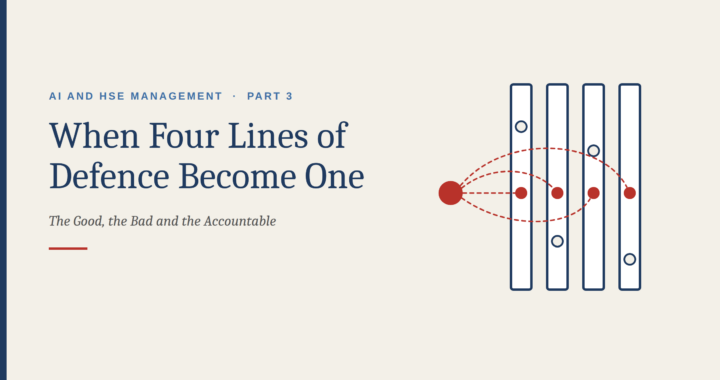
When Four Lines of Defence Become One
The article discusses the risks associated with using AI in Health, Safety, and Environmental (HSE) management, emphasizing that overlapping AI reliance can lead to common-mode failures, undermining independent checks. It highlights the importance of maintaining genuine independence in reviews while encouraging design strategies for effective oversight, ultimately advocating for professional judgement in AI-enhanced processes.
The Fluency Trap
AI can enhance HSE documentation’s appearance but may reduce the skills necessary for meaningful analysis. Professionals must remain engaged in reasoning to prevent deskilling, as reliance on polished outputs can diminish important observational and interpretive abilities. AI’s effectiveness necessitates that human competence in reviewing and executing tasks is upheld.
The Competent HSE Professional, Amplified
AI can make HSE professionals markedly better or quietly worse, depending on how it is used. In the first part of a new series, Randall Shaw makes the positive case: used as a sparring partner rather than a substitute, AI can sharpen professional judgement, not replace it.
Confused About Heat Stress and the GCC Midday Work Ban?
Across the GCC, the summer midday work ban is the most visible heat-safety rule on site — and the most misunderstood. It’s a floor, not a ceiling. Here’s what heat stress actually is, how the six bans differ across the UAE, Saudi, Qatar, Oman, Kuwait and Bahrain, and what your duty of care still requires once the break ends.