AI and HSE Management: The Good, the Bad and the Accountable — Part 3 of 8
Summary
Layers of review only reduce risk if they fail independently. That is the oldest principle in barrier management.
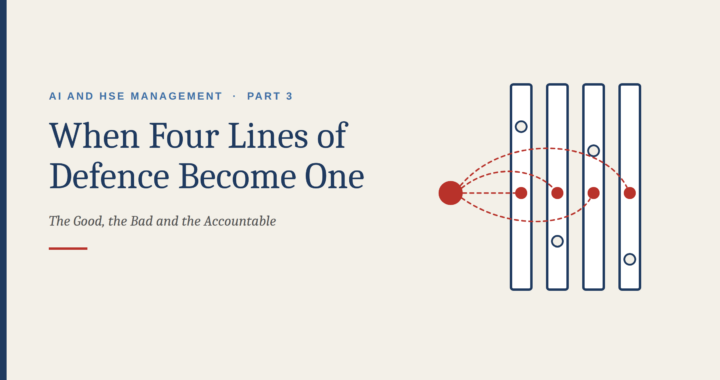
If the worker, supervisor, HSE manager and auditor all rely on the same AI, you may not have four checks. You may have one reasoning system repeated four times.
The paperwork still shows four signatures, so nobody sees the independence disappear.
Leaders should know which of their barriers use AI, and keep at least one genuinely independent check on every high-consequence decision.
In The Fluency Trap I looked at what AI can do to an individual professional: how a polished document can quietly replace the habit of looking, questioning and judging.
This post scales that problem up. What happens when it is not one person relying on AI, but every person in the review chain?
The oldest principle in barrier management
Every HSE professional knows the Swiss cheese model. No single barrier is perfect; each has holes. We stack several barriers so that a failure in one is caught by the next. An incident happens only when the holes line up.
But the model carries an assumption that is easy to forget: the barriers must fail independently. If the holes in one slice are caused by the same thing as the holes in the next, stacking them adds far less protection than it appears to.
Engineers call this common-mode or common-cause failure. Two redundant pumps on the same power supply are not two independent safeguards. Two gas detectors calibrated with the same faulty gas are not two independent measurements. Functional safety standards such as IEC 61508 and IEC 61511 require designers to account for exactly this, because redundancy that shares a weakness is largely an illusion.
We apply this principle rigorously to hardware. We rarely apply it to thinking.
The fluency trap
For most of my career, poor technical work tended to look poor. A weak risk assessment was usually vague, incomplete, badly organised or full of generic phrases. Experienced reviewers learned to read those signals. Structure, precision and confident technical language were imperfect but useful clues to the quality of the thinking behind them.
AI breaks that link. A weak analysis can now be beautifully structured, professionally written, apparently comprehensive and confidently expressed. The surface signals we relied on, often without realising it, no longer tell us anything about the substance.
That is the fluency trap. When the form is always good, the reviewer must judge the substance directly, and that takes more competence than reading the form ever did.
It leads to what I think is the central management implication of AI in HSE:
The more capable AI becomes at producing professional output, the more important independent human competence becomes for checking it.
That sounds like a paradox. It is not. It is simply what happens when quality can no longer be judged by appearance.
Four checks, one mind
Consider a common review chain for a high-risk task.
A supervisor drafts the risk assessment with an AI assistant. The HSE adviser reviews it, and asks the same AI whether anything is missing. The HSE manager signs it off after an AI-generated summary. Later, an auditor uses an AI tool to test whether the controls meet the applicable requirements.
On paper, that is four lines of defence. In practice, every one of them may be drawing on the same model, the same training data, the same assumptions about how such tasks are usually done, and the same blind spots about how they can go wrong.
To be clear, an AI tool does not give everyone an identical answer. But tools built on the same underlying model tend to share the same gaps. If the AI does not think to ask about the backfilled ground beside the crane, it is unlikely to think of it at the second, third or fourth check either.
What you have built is not four independent barriers. It is one reasoning system, consulted four times.
Three ways independence disappears
Shared reasoning. The most obvious route: each person in the chain uses the same tool, or tools built on the same model, to check the work. The checks agree with each other because they come from the same place.
Anchoring. Even where reviewers do not use AI themselves, they review a document that AI has already framed. Research on human judgement has long shown that people adjust from whatever they are shown first, rather than starting afresh. A reviewer presented with a polished, complete-looking risk assessment tends to edit it rather than rethink it. The AI’s framing becomes everyone’s framing.
Shared sources. If the requirements in your legal register were identified by an AI tool and one of them is wrong, every downstream check that relies on that register inherits the same error. The site audit, the gap analysis and the management review all test against the same flawed baseline, and all confirm it.
Why nobody notices
This is what makes common-mode failure so dangerous in a management system. Nothing looks wrong.
Every review genuinely happened. Every signature is real. The audit trail shows four separate people approving the work, which is exactly what a regulator or a board would expect to see. The independence has gone, but the evidence of independence remains.
The same pattern applies at the level of corporate governance. Many organisations organise assurance around three lines: operational management, the risk and compliance function, and internal audit. The model works because each line looks at the business differently. If all three come to rely on the same AI tools, trained on the same material and asked similar questions, the lines start to converge, and the board receives the same answer three times believing it has been tested three ways.
What independence looks like when AI is in the workflow
The answer is not to ban AI from the review chain. It is to design the chain so that at least some of its checks remain genuinely different.
- Vary the method, not just the reviewer. A site walk-down, a conversation with the crew, a physical check of an isolation or a measurement are independent of any document. They catch what the paperwork cannot.
- Go back to the primary source. For compliance decisions, check at least one step against the regulation itself, not against an AI summary of it, or an AI-built register derived from it. This is fundamental to the approach we take at Redlog for developing our legal registers. Every single line item undergoes a rigid human-based review of the primary source.
- Keep one check AI-free for high-consequence work. For the decisions that could potentially several harm someone or create a significant environment impact, at least one competent reviewer should form a view before seeing the AI’s answer.
- Assign a challenger. Ask one reviewer to argue deliberately against the assessment. Disagreement is a sign that independence still exists.
- Know where AI sits in your barriers. Map which reviews, audits and approvals use AI, and which tools. You cannot manage common-mode failure you cannot see.
- Ask your assurance providers. If your auditors and consultants use the same AI tools as your own team, their independence may be weaker than their report suggests.
The question for leaders
Which of your barriers are still genuinely independent?
It is a simple question, and most organisations will struggle to answer it, because the information has never been collected. We will look at how to start answering in our upcoming webinar.
From the barriers to the data
So far this series has been about thinking: what AI does to individual judgement, and what it does to the independence of our checks. The next post turns to something more tangible, and in some ways more immediately dangerous: the information we feed these tools, where it goes, and who else is putting your data into them: Post 4 — The Leak Nobody Noticed.
Why Redlog Is Building for This Future
At Redlog, we are building compliance intelligence tools on the principles set out in my previous series: curated and expert-validated regulatory content, jurisdiction-specific coverage, source traceability, applicability-aware outputs, and an expert-in-the-loop model that keeps professional accountability where it belongs.
This series adds a further principle. AI should strengthen the professional’s judgement, not stand in for it. Tools that show their sources and flag their uncertainty prompt the professional to check, challenge and decide. That keeps them in the left-hand column.
We are publishing this series because the conversation about AI and accountability in HSE should happen inside the profession. It should be shaped by people who understand regulatory compliance, duty of care, operational risk and the consequences of getting this work wrong.
AI will change HSE practice. That is no longer the question. The question is whether the profession will shape that change with judgement, governance and accountability, or allow it to be shaped elsewhere.
If that is how you think AI should work in HSE compliance, it is the conversation we want to have, starting with our webinar.
This is Part 3 of AI and HSE Management: The Good, the Bad and the Accountable. The previous series, AI and the HSSE Profession: What’s Actually Changing, and all of our prior blog posts are available at www.redlogenv.com/blog.
Webinar – Join us on 10 November 2026
Webinar: AI, Accountability and HSE Compliance in MENA — What Every Business Leader Needs to Know
Join us for a discussion with our experts to learn more about where liability sits when AI-assisted compliance work goes wrong, what regulators are starting to expect, and what good governance looks like in practice, and more. Register here

- When Four Lines of Defence Become One - October 15, 2026
- The Fluency Trap - October 15, 2026
- The Competent HSE Professional, Amplified - September 29, 2026