Across the GCC, the summer midday work ban is the most visible heat-safety rule on site — and the most misunderstood. It’s a floor, not a ceiling. Here’s what heat stress actually is, how the six bans differ across the UAE, Saudi, Qatar, Oman, Kuwait and Bahrain, and what your duty of care still requires once the break ends.
Tag Archives: EHS
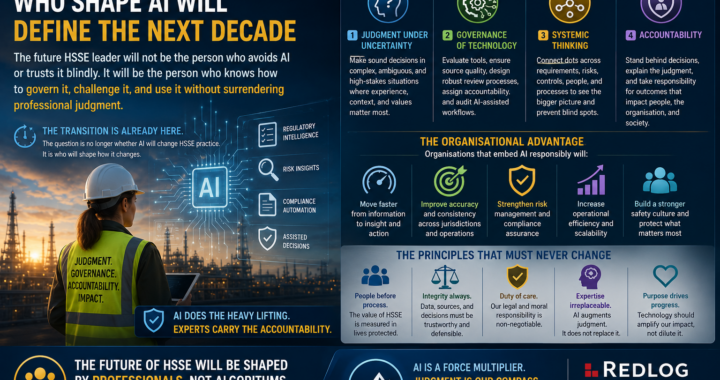
The HSSE Professionals Who Shape AI Will Define the Next Decade
The future HSSE leader will not be the person who avoids AI or trusts it blindly. It will be the professional who knows how to govern it, challenge it, and use it without surrendering judgment. In this final post of the series, I examine why HSSE professionals who shape responsible AI adoption — through governance, systemic thinking, and accountability — will define the next decade of practice.
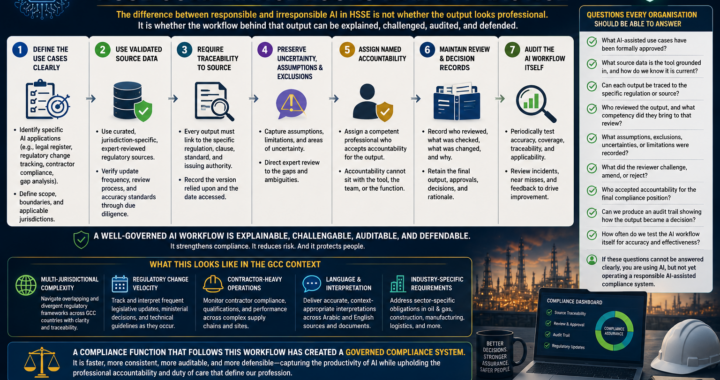
What Responsible AI-Assisted HSSE Compliance Looks Like in Practice
Responsible AI-assisted HSSE compliance is not about polished outputs. It is about whether the workflow behind those outputs can be explained, challenged, audited, and defended. A governed AI compliance system requires clear use cases, validated source data, traceability, documented uncertainty, named accountability, review records, and periodic audit.
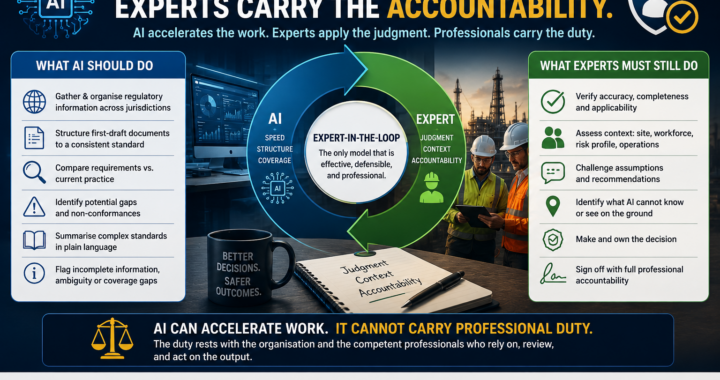
AI Does the Heavy Lifting. Experts Carry the Accountability.
AI can accelerate HSSE compliance work, but it cannot carry professional accountability. The responsible model is AI-assisted, expert-governed compliance: AI gathers, structures, and flags information, while qualified professionals validate applicability, challenge assumptions, contextualise findings, and sign off with full professional judgment.
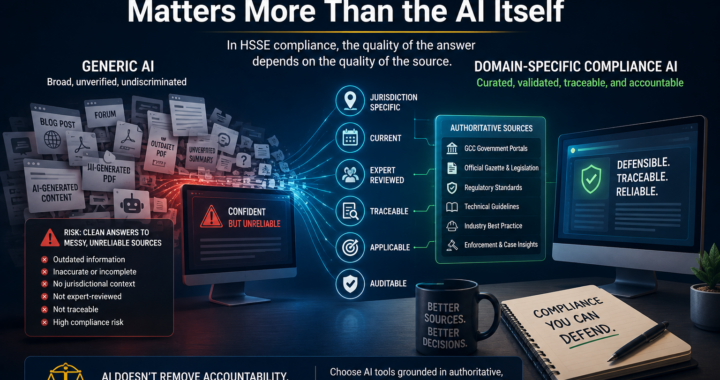
Why the Source of Your AI Matters More Than the AI Itself
Why the Source of Your AI Matters More Than the AI Itself
Most organisations evaluating AI for HSSE compliance start with the wrong question. They ask how powerful the AI is. The right question is what the AI knows, where that knowledge came from, and who is accountable for keeping it right.
Not all AI tools are equal — and for compliance work, the difference is not about interface quality or response speed. It is about whether the outputs are grounded in authoritative, jurisdiction-specific, expert-reviewed, and regularly updated regulatory content that can be traced back to its source.
This post sets out five tests any AI compliance tool should be able to meet before it is trusted with decisions that carry legal, professional, and moral accountability — and the questions every organisation should ask any vendor before deploying AI in an HSSE function.