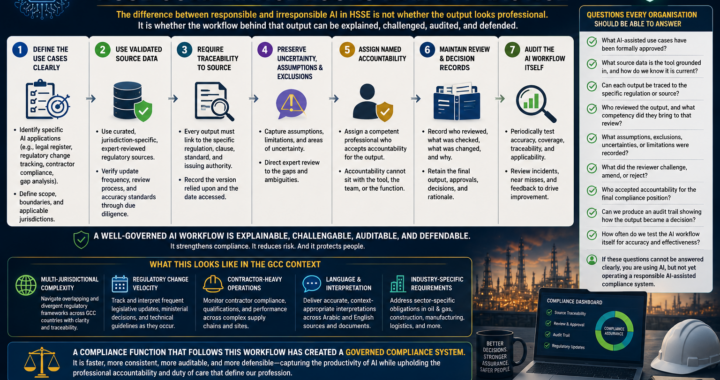
The difference between responsible and irresponsible AI in HSSE is not whether the output looks professional. It is whether the workflow behind that output can be explained, challenged, audited, and defended.
The previous posts in this series have built the case for why AI in HSSE compliance requires serious governance — not as a bureaucratic overlay, but as the structural condition that makes AI use defensible under the duty of care obligations that govern the profession.
This post moves from argument to framework. Because responsible AI adoption in HSSE is not only a technology question. It is a workflow question. The tools matter, but what matters more is how they are embedded into compliance practice — with what governance, what accountability, what records, and what audit trail.
There is a significant difference between using AI in compliance work and operating an AI-assisted compliance system. The first may improve productivity. The second can be governed, audited, and defended.
A well-governed AI compliance workflow can be explained clearly to a regulator, challenged by an auditor, and defended in an investigation. A poorly governed one looks fine until something goes wrong — at which point the absence of structure becomes the finding.
Here is what the responsible model looks like in practice.
Step 1: Define the use cases clearly
Responsible AI adoption starts with precision about what the tool is being used for. Not “AI for compliance” in general terms — but specific, defined use cases with clear scope and clear boundaries.
In HSSE compliance, the use cases where AI delivers the most value — and where the governance requirements are most clearly defined — include legal register development and maintenance, regulatory change tracking, contractor compliance monitoring, gap analysis against management system standards, and audit preparation and reporting.
Each use case has a different risk profile, different source data requirements, and different competency requirements for the reviewer. Defining them explicitly allows the organisation to apply appropriate governance to each — rather than applying uniform assumptions to a diverse set of activities that carry different consequences if they go wrong.
In the GCC context, where organisations routinely operate across multiple jurisdictions with overlapping and sometimes conflicting regulatory frameworks, defining use cases also means defining which jurisdictions each application covers — and being explicit about what is out of scope.
Step 2: Use validated source data
The principle established in Post 4 of this series applies directly here: the output is only as reliable as what the tool is grounded in.
A responsible AI compliance workflow specifies the source data the tool draws from — and that source data must be validated, current, jurisdiction-specific, and expert-reviewed. This is not a vendor assurance to be accepted on the basis of marketing materials. It is a governance requirement to be verified through due diligence: what are the specific regulatory databases and primary sources the tool retrieves from? How frequently are they updated? Who conducts the review? What is the documented standard of accuracy?
For legal register applications in the GCC, this means the tool must be drawing from current national legislation and executive regulations for each jurisdiction it covers — not international standards applied as proxies, not summaries of requirements, not content that has not been reviewed by professionals with knowledge of local regulatory practice.
Step 3: Require traceability to source
Every output from an AI compliance tool used in a professional HSSE function should be traceable to its source — the specific regulation, the specific clause, the specific issuing authority, and the date of the version relied upon.
Traceability is not a technical nicety. It is what makes a compliance position defensible. In an audit, a regulatory inspection, or an incident investigation, “the AI tool identified this requirement” is not a sufficient answer. “The requirement is set out in Article 12 of Ministerial Decision No. X, issued by the relevant authority, effective [date], and our compliance assessment was conducted against that version” is.
A tool that cannot provide that traceability is not fit for professional compliance use, regardless of how capable or well-designed it is in other respects. And a workflow that accepts AI outputs without building that traceability into its records is creating a compliance position that looks robust and cannot be defended.
Step 4: Preserve uncertainty, assumptions, and exclusions
One of the most important — and most frequently overlooked — requirements of a responsible AI compliance workflow is the explicit documentation of what the tool did not cover, what it flagged as uncertain, and what assumptions underlie its outputs.
AI tools that present complete, confident outputs without flagging uncertainty are, as Post 3 of this series established, a specific category of risk. A responsible workflow addresses this by requiring that uncertainty, assumptions, and exclusions are explicitly recorded — not resolved silently into a clean output.
This serves two purposes. First, it directs expert review to the areas that most need it — the gaps, the ambiguities, the jurisdictions or regulatory areas where the tool’s coverage is less complete. Second, it creates a record that demonstrates the compliance assessment was conducted with appropriate professional scepticism — that the organisation did not simply accept the output, but evaluated it critically and documented the limits of its reliance on it.
Step 5: Assign named accountability
Every AI-assisted compliance output that informs a decision, a control, or a regulatory position should have a named accountable professional — not a team, not a function, not a tool — whose judgment it reflects and whose professional duty encompasses it.
Named accountability is the mechanism that connects the AI workflow to the duty of care framework. It is what converts “the system generated this” into “a qualified professional reviewed, validated, and accepted responsibility for this.” It is also the mechanism that incentivises genuine review rather than administrative sign-off — because the professional whose name is attached to the output has a direct interest in ensuring that the output meets the standard their name implies.
In organisations where AI compliance outputs are circulated without named accountability — where the assumption is that responsibility is distributed across the team or rests with the tool — the accountability gap that Post 2 described is not theoretical. It is structural.
Step 6: Maintain records of review and decision-making
A responsible AI compliance workflow generates records that demonstrate not just what the output was, but how it was reviewed, what the reviewer evaluated, what they challenged or amended, and what professional judgment they applied.
These records are not primarily about compliance with a documentation requirement. They are about creating the audit trail that makes the compliance position defensible — to a regulator, to an auditor, to a court, or to an investigation panel. The standard is not “we have a record that the review happened.” It is “we have a record that demonstrates what the review consisted of and the professional basis on which the output was accepted.”
For HSSE functions operating across the GCC, where regulatory inspections are increasingly rigorous and where the consequences of a demonstrated compliance gap can include operational suspension, financial penalty, and personal liability for responsible officers, this audit trail is not optional bureaucracy. It is operational risk management.
Step 7: Audit the AI workflow itself
A compliance function that uses AI should treat the AI workflow as an auditable element of the management system — subject to the same periodic review and verification as any other compliance process.
This means periodically testing the quality of the tool’s outputs against independent verification of the applicable regulatory requirements. It means reviewing whether the source data remains current and whether the update process is functioning as specified. It means assessing whether the expert review step is being conducted to the required standard — or whether, over time, it has drifted toward the administrative sign-off pattern that provides the appearance of review without the substance.
It also means staying current with developments in the regulatory and technical landscape that might affect the tool’s coverage — new legislation, revised standards, changed enforcement priorities — and ensuring that the tool’s update process reflects those developments within an acceptable timeframe.
What this looks like in the GCC context
The governance framework above applies universally. In the GCC context, several features of the regulatory environment make it particularly important.
Multi-jurisdictional complexity is the baseline condition for most multinational organisations operating in the region. A responsible AI compliance workflow must be explicit about which jurisdiction each output covers, and must not allow requirements from one country to be applied as proxies for another. The differences between UAE, Saudi, Qatari, and Omani regulatory requirements — in occupational health, environmental management, and contractor obligations — are material and consequential.
Regulatory change velocity in the GCC is significant. Vision 2030 and equivalent national programmes across the region are driving substantial legislative and regulatory development. An AI compliance tool that is not updated frequently enough to track this change is not providing compliance assurance — it is providing a historical snapshot, presented as current.
Contractor-heavy operations, which characterise most major projects in the region, create a compliance perimeter that extends well beyond the direct employer. AI-assisted contractor compliance monitoring — tracking obligations, verifying competencies, flagging gaps — is one of the highest-value use cases in the GCC context, and one where the governance requirements are particularly demanding given the number of parties, the pace of workforce change, and the multi-jurisdictional workforce profiles involved.
Language and interpretation present a specific challenge. Where regulatory content exists in Arabic and the workforce and management operate in English, or vice versa, the translation and interpretation step introduces a point of potential error that a responsible workflow must explicitly address — including verifying that AI-assisted translation of regulatory content has been reviewed by a professional with competency in both the language and the regulatory context.
Questions every organisation should be able to answer
An organisation using AI in an HSSE compliance function should be able to answer a simple set of questions.
- What AI-assisted use cases have been formally approved?
- What source data is the tool grounded in, and how do we know that source data is current?
- Can each output be traced to the specific regulation, clause, standard, or source on which it relies?
- Who reviewed the output, and what competency did they bring to that review?
- What assumptions, exclusions, uncertainties, or limitations were recorded?
- What did the reviewer challenge, amend, or reject?
- Who accepted accountability for the final compliance position?
- Can the organisation produce an audit trail showing how the output became a decision?
If those questions cannot be answered clearly, the organisation may be using AI, but it is not yet operating a responsible AI-assisted compliance system.
The system serious compliance functions need
A compliance function that has implemented the workflow above — defined use cases, validated source data, source traceability, documented uncertainty, named accountability, review records, and periodic audit — has created something qualitatively different from a function that simply uses AI.
It has created a governed compliance system.
That system is faster and more consistent than manual compliance management. More importantly, it is more auditable, more defensible, and more likely to identify gaps before they become incidents. It captures the productivity benefits of AI while preserving — and in some respects strengthening — the professional accountability structure that duty of care requires.
This is not a future aspiration. It is an achievable standard. The tools and governance frameworks to support it already exist. The organisations that implement them now will be better positioned — operationally, legally, and reputationally — than those that wait for an incident to make the case for them.

- Confused About Heat Stress and the GCC Midday Work Ban? - June 27, 2026
- The HSSE Professionals Who Shape AI Will Define the Next Decade - June 19, 2026
- What Responsible AI-Assisted HSSE Compliance Looks Like in Practice - June 16, 2026