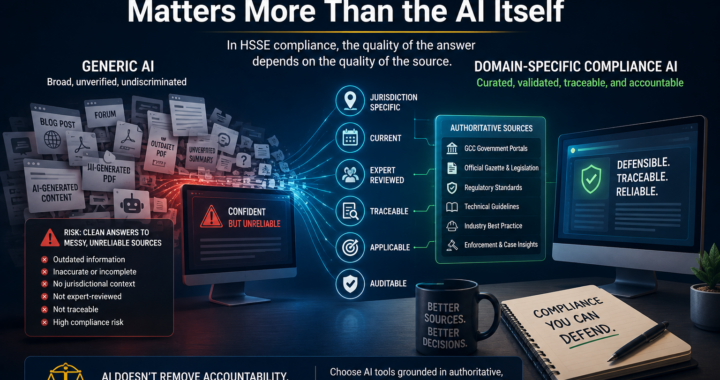
The most important question in AI-assisted HSSE compliance is not “how powerful is the AI?” It is “what does the AI know, where did that knowledge come from, and who is accountable for keeping it right?”
There is something seductive about a clean answer.
The conversation about AI in most organisations starts in the wrong place.
It starts with capability. How sophisticated is the model? How natural does it sound? How fast does it respond? How many languages does it handle? These are reasonable questions for a general-purpose tool. They are the wrong questions for a compliance function where the outputs inform legal register management, risk assessment, incident investigation, and regulatory reporting – and where the consequences of a wrong answer are not a wasted hour but an undetected compliance gap, a failed audit, or a worker harmed by a control that looked adequate and was not.
For HSSE compliance, capability is table stakes. What matters is grounding. And grounding is not a feature. It is a fundamental design decision that determines whether an AI tool is fit for professional use or merely impressive in a demonstration.
In the previous post, I argued that AI can produce clean, confident answers to messy HSSE problems – and that those answers may be wrong in ways that are difficult to see. This post turns to the next question: if generic AI creates that risk, what makes an AI tool safer, more defensible, and more suitable for compliance work?
The false comparison: not all AI is equal
When HSSE professionals or procurement teams evaluate AI tools, they frequently compare tools that are not, in any meaningful sense, comparable.
On one side are general-purpose large language models – the technology behind widely used AI assistants. These tools have been exposed to vast quantities of text across every conceivable subject. They are fluent, responsive, and capable of producing outputs that look authoritative across almost any domain, including HSSE compliance. Their knowledge of any specific domain is broad, shallow, and unverified. They have no mechanism for distinguishing a peer-reviewed technical standard from a blog post that summarises it inaccurately. They do not know what they do not know, and they do not say so.
On the other side are domain-specific compliance intelligence tools – AI systems designed for a specific professional context, connected to curated, authoritative source material, validated by subject matter experts, and built to produce outputs that are traceable back to the regulatory and technical sources they draw from. These tools are not trying to know everything. They are trying to know the right things, reliably, with accountability for the accuracy of what they produce.
These are not two points on the same spectrum. They are different classes of tool, built for different purposes, carrying different risk profiles, and requiring different governance frameworks. Comparing them on the basis of interface quality or response fluency is like evaluating a structural engineering report and a marketing brochure by the quality of the typography.
The relevant distinction is not whether the model has been exposed to more information. It is whether its answers are grounded in controlled, current, and traceable regulatory sources.
The five tests of authoritative compliance AI
The word authoritative is used loosely in discussions of AI. In HSSE compliance practice, it has a specific and demanding meaning. A tool is not authoritative because it sounds certain. It is authoritative only if the knowledge behind the answer can meet five tests.
1. Jurisdiction-specific
An authoritative regulatory source is jurisdiction-specific. The occupational health requirements applicable to a construction project in Abu Dhabi are not the same as those in Riyadh, Doha, or Muscat. A compliance tool that blends requirements across jurisdictions – or draws on international standards without anchoring them to local legislative instruments – is not providing compliance intelligence. It is providing a plausible approximation that may or may not reflect what the law actually requires in the specific context where the work is being done.
2. Current
An authoritative source is current. Regulatory frameworks are not static. Ministerial decisions, executive regulations, technical guidelines, and enforcement priorities change. A legal register is only as valuable as the currency of the information it is built on. A compliance tool that retrieves from a database that has not been reviewed against recent regulatory change is not providing compliance assurance. It is providing a snapshot of what compliance looked like when the database was last updated.
3. Expert-reviewed
An authoritative source is expert-reviewed. Regulatory language is frequently technical, occasionally ambiguous, and sometimes interpreted differently by different enforcement bodies. The difference between what a regulation says and what it means in practice – in a specific industry, on a specific type of site, under a specific enforcement regime – requires expert interpretation, not just accurate transcription. A compliance tool grounded in expert-reviewed content carries that interpretation as part of its output. A tool drawing from unreviewed sources does not.
4. Traceable
An authoritative source is traceable. In any compliance function, the ability to trace an obligation back to its source – the specific regulation, the specific clause, the specific issuing authority – is not optional. It is what makes the compliance position defensible in an audit, an investigation, or a legal proceeding. A tool that produces compliance outputs without source traceability is producing assertions, not evidence.
5. Applicability-aware
An authoritative compliance system must also preserve applicability. It should not simply retrieve a requirement. It should help the practitioner understand whether that requirement applies to the specific activity, site, jurisdiction, material, workforce, contractor arrangement, threshold, exemption, or operating condition in question.
This matters because legal registers are not just lists of laws. They are applicability judgments. A requirement can be real, current, and correctly cited, yet still be irrelevant to a particular operation – or highly relevant because a threshold, exemption, or site condition brings it into scope. In regulatory compliance, the difficult question is rarely only “what does the rule say?” It is “does this rule apply here, to this activity, under these facts?”
Why source quality drives output quality
The relationship between source quality and output quality in AI-assisted compliance is direct and unforgiving.
A general-purpose AI produces outputs that reflect the aggregate of everything it has been exposed to – the good, the bad, the outdated, the misunderstood, and the fabricated. When that aggregate includes authoritative regulatory content, the output may be correct. When it includes simplified summaries, outdated guidance, jurisdiction-general approximations, and AI-generated content from earlier model generations, the output will reflect that too – presented with identical confidence either way.
This is not a problem that better prompting solves by itself. It is not a problem that more careful use solves by itself. It is a source problem. The output can only be as reliable as what the tool is drawing from. And for a general-purpose model, there is no mechanism – and no accountability – for ensuring that what it draws from meets the standard that HSSE compliance requires.
A compliance intelligence tool grounded in a curated, validated, and regularly updated regulatory database does not have this problem in the same form. Its outputs are anchored to specific source material. When the source is current, expert-reviewed, jurisdiction-specific, and applicability-aware, the output can inherit those qualities. When the source is updated to reflect a regulatory change, the output can reflect the new position. When an output is challenged, it can be traced back to the underlying source and evaluated against it.
The issue is not whether the model was exposed to everything. It is whether the answer is grounded in the right things: current law, validated regulatory data, expert interpretation, applicability logic, and traceable source material.
The procurement mistake
Most organisations that adopt AI tools for compliance functions treat the decision as a software procurement exercise. They evaluate user interface, integration capability, pricing, vendor reputation, and implementation support. While these are legitimate considerations, they are not the only ones..
Selecting an AI tool for use in HSSE compliance is a risk management decision. It carries the same governance requirements as any other decision that affects how regulatory obligations are identified, how controls are determined, and how compliance is assured. The AI tool becomes part of the compliance system. Its outputs inform decisions that carry legal, professional, and moral accountability. The quality of those outputs – and the defensibility of the process that produced them – is a compliance matter, not a technology matter.
Treated as a risk management decision, the evaluation criteria change. The question is not “does this tool work well?” It is “can this tool produce outputs that are defensible under the duty of care and labour law obligations that govern our operations?” That question has a different answer for a general-purpose AI assistant and a domain-specific compliance intelligence tool grounded in authoritative, expert-validated regulatory content.
What to ask any AI vendor before deploying in a compliance function
The following questions are not exhaustive, but they are a reasonable starting point for any organisation evaluating AI tools for HSSE compliance use. The answers will quickly distinguish between tools that are fit for professional use and those that are not.
What is the tool grounded in? Specifically, what regulatory sources, technical standards, and expert content does the tool retrieve from or anchor its outputs to? Is that source material documented and available for review?
Who maintains the source content, and how frequently is it updated? Regulatory content changes. The update discipline of the underlying source material is a direct determinant of the currency and reliability of the output.
Is the content jurisdiction-specific? For organisations operating across multiple GCC countries or internationally, does the tool distinguish between the requirements of different jurisdictions, or does it blend them?
How does the tool determine applicability? Does it distinguish between requirements that are generally relevant and requirements that actually apply to a specific activity, facility, material, workforce, contractor arrangement, or jurisdictional threshold?
Are outputs traceable to source? Can the tool identify the specific regulation, clause, or standard that underpins a given output? Can that source be independently verified?
Does the system preserve an audit trail? Can the organisation see what was asked, what sources were used, what answer was produced, who reviewed it, and what decision was made?
Who is accountable for the accuracy of the source content? Not the AI model – the content. Is there a named team, a documented review process, and an explicit standard of accuracy that the vendor stands behind?
How does the tool handle uncertainty or gaps in its source material? Does it flag when a question falls outside its validated coverage, or does it generate a plausible-sounding answer regardless?
What governance framework does the vendor recommend for professional use? A vendor that does not have a clear answer to this question has not thought seriously about how its tool will be used in practice.
What a proper compliance intelligence system looks like
An AI tool that is genuinely fit for HSSE compliance use is not defined by its model architecture. It is defined by what it is connected to, how that connection is maintained, and what accountability sits around it.
It is grounded in regulatory databases that are curated by professionals with deep knowledge of the jurisdictions they cover. It is validated against primary legislative sources – not summaries, not approximations, not AI-generated interpretations of earlier interpretations. It is updated through a defined process that reflects the pace of regulatory change in the jurisdictions it covers. It produces outputs that are traceable to their sources, so that a compliance professional can verify, audit, and stand behind what the tool produces.
A defensible system should also leave an audit trail. It should be possible to see what was asked, what sources were consulted, what answer was produced, who reviewed it, what assumptions or limitations were recorded, and what decision was ultimately made. Without that record, an organisation may have an AI output, but it does not have a defensible compliance process.
And it is designed with an explicit understanding that the professional using it carries the accountability for the outputs – which means the tool’s job is to make that professional’s judgment better informed, more efficient, and more defensible. Not to replace that judgment. Not to create the illusion of compliance where compliance has not been verified. But to give a qualified practitioner the best possible foundation on which to exercise the expertise that no AI system can replicate.
That is the standard. It is achievable. And it is the minimum standard consistent with the duty of care obligations that govern HSSE practice. But even the best-grounded AI tool does not remove the need for professional judgment. It changes where that judgment is applied. The next question is therefore not whether AI can support compliance work. It is how qualified experts should supervise, validate, and stand behind what AI produces.

- The Leak Nobody Noticed - October 19, 2026
- When Four Lines of Defence Become One - October 15, 2026
- The Fluency Trap - October 15, 2026