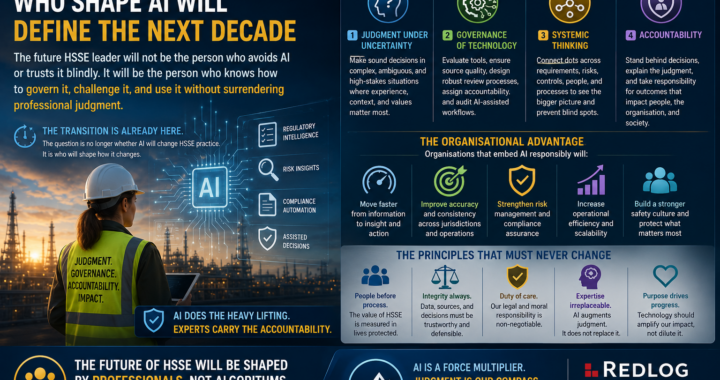
The future HSSE leader will not be the person who avoids AI or trusts it blindly. It will be the person who knows how to govern it, challenge it, and use it without surrendering professional judgment.
This is the final post in a series that began with a provocation: that the HSSE profession is talking about AI without yet understanding what it will do to the profession.
Across the series, the argument has moved from disruption, to accountability, to the failure modes of generic AI, to the conditions required for responsible use.
I want to close not with another warning, but with a challenge – and with a reason for optimism.
The transition is already underway. Organisations are using AI in compliance functions. Professionals are building literacy with these tools. Vendors are investing in domain-specific regulatory intelligence. These are not future developments. They are present ones.
The question is no longer whether AI will change HSSE practice. It is who will shape how it changes.
The Profession Has Adapted Before
The HSSE profession is not unfamiliar with transformation. It has absorbed changes that, at the time, seemed as disruptive as the current moment.
The formalisation of management systems – ISO 14001, OHSAS 18001, ISO 45001 – changed the structure of professional practice. Digitalisation changed how records were kept, how audits were conducted, and how compliance was tracked. The broadening of scope from occupational safety into health, environment, and security expanded the professional domain significantly.
Each of these transitions produced anxiety, resistance, and eventually adaptation. The professionals who engaged early helped shape the standards, frameworks, and practices that followed. Those who waited inherited a version of the profession shaped by others.
I expect that the AI transition will follow the same pattern. It differs in scale and pace – the changes it will drive are more fundamental and faster than previous waves. But the adaptive logic is familiar: engage, develop literacy, shape the direction, and be positioned to lead when the transition matures.
Why This Transition is Different
What makes the current moment genuinely distinct is not only the technology itself. It is what the technology changes.
Previous transformations changed how HSSE work was organised, recorded, and managed.
AI changes something more fundamental: how professional work is produced.
Research, drafting, comparison, summarisation, and gap analysis can now be performed at speed and scale by AI systems. What remains irreplaceable is not the first output. It is the professional judgment applied to that output.
That is a more fundamental change. It requires not just learning new tools but rethinking what professional value consists of – and being honest about which aspects of HSSE practice have always depended on judgment, and which have been information-processing work that AI can now perform faster.
The New Strategic HSSE Role
The HSSE professional who thrives in an AI-integrated environment will not be defined by how many regulations they can recall from memory. They will be defined by four capabilities that AI cannot carry on their behalf.
The first is judgment under uncertainty. Real HSSE decisions are rarely made with complete information, clear regulatory guidance, and straightforward risk profiles. They are made in conditions of ambiguity, operational pressure, competing priorities, and imperfect knowledge. The ability to make sound decisions in those conditions – drawing on regulatory understanding, operational context, risk reasoning, and professional experience – remains central to the profession.
The second is governance of technology. As AI becomes embedded in compliance workflows, organisations need professionals who understand not just how to use AI tools, but how to govern them: how to evaluate source quality, design review processes, assign accountability, preserve traceability, and audit AI-assisted workflows to a standard that duty of care requires.
The third is systemic thinking. AI can produce outputs at the level of specific requirements, controls, documents, or findings. The professional who understands how those outputs connect – how a legal register links to a risk assessment, how a risk assessment links to a control hierarchy, how controls link to training, contractor obligations, assurance, and incident learning – is providing value that no AI tool currently approaches.
The fourth is accountability. This is not a skill in the conventional sense. It is a professional disposition: the willingness to stand behind a compliance position, explain the judgment to the regulator, defend it to an auditor, and answer for it if the decision is challenged after an incident.
AI produces no accountability. Professionals do. In an industry where the consequences of getting it wrong include serious injury, environmental harm, and death, that accountability is not a burden to be avoided. It is the profession’s defining value.
The Organisational Advantage
Organisations that develop these capabilities – that invest in AI governance, build competent review processes, and position their HSSE professionals to lead the integration of AI into compliance functions – gain advantages that extend well beyond efficiency.
They are faster. AI-assisted legal register management, regulatory change tracking, and audit preparation reduce the time between regulatory change and compliance response. In regulatory environments evolving as rapidly as those across the GCC, that speed matters.
They are more auditable. A governed AI workflow generates records, traceability, and documented accountability. It demonstrates not just what the compliance position is, but how it was reached, what sources were relied on, what assumptions were made, who reviewed it, and who accepted responsibility for it.
They are better defended. When an incident occurs – and in organisations of sufficient scale, incidents will occur – the organisation that can demonstrate a rigorous, governed compliance process is in a fundamentally different position from one that cannot. A robust AI governance framework is not just risk management. It is evidence of organisational competence.
And they attract the professionals the future requires. HSSE practitioners who are building AI literacy, governance expertise, and confidence in expert review will want to work in organisations that take these capabilities seriously. They will not be satisfied with tools that create speed without accountability, or automation without defensible assurance.
The Professional Challenge
I want to be direct about what this series has been building toward – not as a conclusion, but as an invitation.
The HSSE profession is at an inflection point. The tools are changing faster than the profession is adapting. The broad accountability principles are already clear. The failure modes of irresponsible AI use are predictable. The governance model that makes AI use defensible is achievable. And for organisations that implement it well, the advantages are real.
What is needed now is professionals who choose to engage – not with uncritical enthusiasm, and not with resistance that mistakes familiarity with the old model for mastery of the new one, but with the same rigorous, evidence-based approach that good HSSE practice has always required.
How?
Learn how the tools work.
Understand their failure modes.
Develop the competency to review their outputs critically.
Build the governance structures that make their use defensible.
Ask what source material the tool is grounded in.
Ask how uncertainty is preserved.
Ask who is accountable.
Ask whether the workflow can be explained, challenged, audited, and defended.
Then be the professional in your organisation who shapes how AI is used – not the one who inherits a version of that decision made by someone else.
The window to lead this transition is open. It will not remain open indefinitely.
Why Redlog Is Building for This Future
Throughout this series I have written from inside the transition, not as an observer of it. At Redlog, we are building compliance intelligence tools around the principles this series has described: curated and expert-validated regulatory content, jurisdiction-specific coverage, source traceability, applicability-aware outputs, and an expert-in-the-loop model that recognises where professional accountability must remain.
We are building these tools because we believe the HSSE profession needs AI designed for the realities of compliance work – not general-purpose technology applied to a high-risk professional context it was not built to understand.
And we are publishing this series because the conversation about responsible AI in HSSE should happen inside the profession. It should be shaped by people who understand regulatory compliance, duty of care, operational risk, and the consequences of getting this work wrong.
If the framework described in this series reflects how you think responsible AI-assisted compliance should work – source-grounded, expert-reviewed, traceable, auditable, and accountable – then that is exactly the conversation Redlog wants to have with the profession.
AI will change HSSE practice. That is no longer the question.
The question is whether the profession will shape that change with judgment, governance, and accountability — or whether it will allow the future of HSSE practice to be shaped elsewhere.
The professionals who choose to engage now will define the next decade.
This post concludes the series: AI and the HSSE Profession – What’s Actually Changing. All posts are available at www.redlogenv.com/blog.

- Confused About Heat Stress and the GCC Midday Work Ban? - June 27, 2026
- The HSSE Professionals Who Shape AI Will Define the Next Decade - June 19, 2026
- What Responsible AI-Assisted HSSE Compliance Looks Like in Practice - June 16, 2026