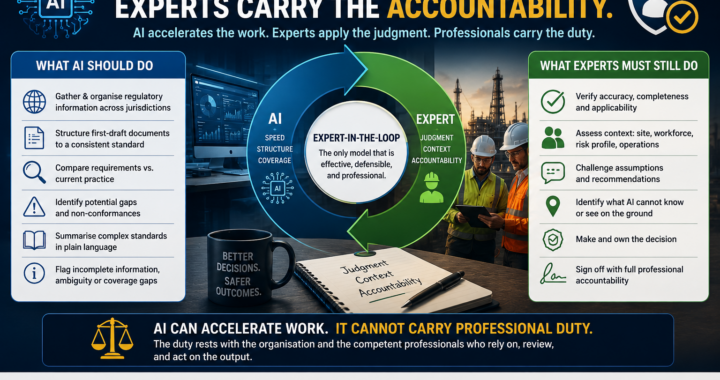
The wrong question is whether AI replaces HSSE professionals. The right question is what AI should do, what experts must still do, and why the difference between those two things is a matter of professional duty — and in our industry, sometimes a matter of life and death.
Every serious conversation about AI in the workplace eventually arrives at the same anxiety: will it replace us? In many professions, that question is worth asking. In HSSE, it is the wrong question — and spending too much time on it distracts from the one that actually matters.
The question that matters is this: when an AI tool is used in an HSSE compliance function and something goes wrong, who carries the duty? Who explains the decision to the regulator? Who stands in front of the investigation panel and accounts for the control that failed?
The answer has not changed. The duty rests with the organisation and the competent professionals who rely on, review, and act on the output. AI can accelerate the work. It cannot carry the professional duty.
In the previous post, I argued that the source of an AI system matters more than the apparent sophistication of the AI itself. A compliance tool is only as defensible as the regulatory content, expert validation, traceability, and applicability logic behind it. This post turns to the next question: once an organisation has a properly grounded tool, how should it be used?
The answer is not blind trust. It is not manual duplication of everything the AI produces. It is a structured model in which AI does what it is good at, and qualified professionals do what they remain accountable for.
The right model: AI-assisted, expert-governed compliance
The responsible model for AI use in HSSE compliance is not AI instead of experts. It is AI accelerating structured work while qualified professionals validate applicability, contextualise findings, challenge assumptions, and take accountability for final decisions.
This is not a defensive compromise. It is the model that captures the genuine productivity gains AI can deliver — speed, consistency, breadth of coverage, and better access to structured information — without pretending that professional judgment has been automated.
The model has a name in AI governance: expert-in-the-loop. In HSSE practice, it is simply what competent professional use of any serious tool looks like. The AI is an instrument. The expert is the professional accountable for how it is used and what is done with its outputs.
That distinction matters. If AI is treated as the decision-maker, the organisation is exposed. If AI is treated as an accelerator of expert judgment, the organisation can build a workflow that is faster, more consistent, and more defensible than the manual process it replaces.
What AI should do
Used within this model, AI should handle the work that is time-consuming, volume-intensive, and pattern-dependent — the work that stretches HSSE teams and creates the conditions for gaps and errors.
It can gather and organise regulatory information across multiple jurisdictions, identify potentially applicable requirements, flag recent changes, and structure first-draft outputs such as legal registers, gap analyses, audit preparation notes, incident investigation summaries, and corrective action plans.
It can compare current practice against applicable requirements and identify potential non-conformances. It can summarise complex regulatory or technical content in language that operational teams can understand. It can highlight where information is missing, where a requirement appears ambiguous, or where a question falls outside its validated source material.
Done well, this frees the expert to spend less time assembling information and more time evaluating it. That is the real productivity gain. Not replacing professional judgment, but giving that judgment better inputs, faster.
Done without expert oversight, however, the same capability creates outputs that look complete and authoritative regardless of whether they are correct, applicable, or safe to rely on.
What AI should not do
AI should not be treated as the accountable decision-maker in HSSE compliance. It should not be allowed to turn uncertain or incomplete information into an unqualified answer. It should not be used to bypass competent review because the output looks professional. And it should not be used in a compliance workflow where no one can explain the source of the answer, the assumptions behind it, or the basis on which it was accepted.
These boundaries are not anti-technology. They are basic risk controls. The more powerful and persuasive the tool becomes, the more important those boundaries are.
A mature AI compliance workflow should make clear what the AI has done, what it has not done, what sources it relied on, what uncertainty remains, and what human judgment is required before the output can be used. Without those distinctions, AI does not reduce risk. It obscures where the risk has moved.
What experts must still do
The expert’s role in an AI-assisted compliance workflow is not to read the output and approve it. That is administration, not expertise, and it provides neither professional value nor meaningful legal protection.
Real expert review is substantive. It means evaluating whether the regulatory requirements the AI has identified are correct and complete for the specific jurisdiction and operational context — not just whether they look reasonable. It means assessing whether the controls or corrective actions the AI has recommended are adequate for the specific site, workforce, contractor arrangement, and risk profile — not just whether they meet general criteria.
It means identifying what the AI has not flagged: the regulatory interpretation that requires local knowledge, the site condition that changes the risk picture, the workforce characteristic that makes a standard control inadequate, or the organisational weakness that turns a written procedure into a paper control.
It also means contextualising. An AI tool may know the regulatory source material it is connected to. It may even know organisation-specific data if it has been deliberately integrated and validated. But it does not walk the site, hear the hesitation in a supervisor’s answer, understand the informal workarounds crews use to keep production moving, or sense the gap between the management system and the way work is actually done.
Those realities matter. They are often where serious incidents begin. Only a competent professional with knowledge of the operation can bring that context to bear.
And it means signing off with full awareness of what that signature represents: a professional judgment that the output has been critically evaluated, that it is fit for the purpose to which it will be applied, and that the organisation can rely on it as the basis for compliance decisions.
Why review is not administration
There is a version of the expert-in-the-loop model that fails — and it fails precisely because it is treated as an administrative step rather than a professional one.
It looks like this: an AI tool generates a compliance output, it is sent to a qualified professional for sign-off, the professional checks that it looks complete and professionally formatted, and approves it. The output enters the compliance system. The professional’s name is attached to it.
This is not expert review. It is the appearance of expert review — which, as discussed earlier in this series, is one of the most dangerous conditions in HSSE practice. False assurance at the point where genuine assurance was needed.
The difference between administration and genuine review is judgment. Judgment requires regulatory knowledge — knowing the landscape well enough to identify when something is missing or wrong. It requires site understanding — knowing the operational context well enough to assess whether a general control is adequate for specific conditions. It requires risk reasoning — the ability to think through failure modes, not just check boxes. And it requires professional scepticism — the disposition to question outputs rather than accept them, to look for what has been missed rather than confirm what is present.
These are not qualities that come automatically with a job title, years of service, or professional registration. They are developed through deliberate practice, applied experience, and continuous learning — including learning how to critically evaluate the AI tools that are now becoming part of the profession’s toolkit.
What makes a competent reviewer
The standard for competent review of AI-assisted HSSE outputs is not lower than the standard for competent production of those outputs manually. In some respects it is higher.
A competent reviewer needs enough regulatory knowledge to identify hallucinated, outdated, incomplete, or misapplied requirements. They need enough site and operational knowledge to identify where a general output is inadequate for specific conditions. They need enough understanding of AI failure modes — hallucination, overconfidence, simplification, false authority — to know where to look hardest.
They also need the professional confidence to challenge and reject outputs that do not meet the required standard, even when those outputs are well-formatted, confidently presented, and produced by a tool the organisation has invested in.
In practical terms, competent review means asking questions such as: What source is this answer grounded in? Is the source current? Does the requirement actually apply to this activity or site? What assumptions has the tool made? What uncertainty remains? What local enforcement expectation or operational reality might change the answer? What evidence would we show if this decision were challenged in an audit or investigation?
This is a demanding standard. It is also the standard consistent with the duty of care obligations that govern HSSE practice — and with the professional obligations that govern anyone who puts their name on a compliance assessment.
Organisations that deploy AI in HSSE compliance functions without ensuring that the review function meets this standard are not managing risk. They are redistributing it — from the AI tool, which carries none, to the organisation and the professionals whose names are on the outputs.
What this means for how compliance AI should be built
The expert-in-the-loop model is not just a governance framework for organisations using AI. It is a design requirement for any AI tool that is serious about being fit for professional HSSE compliance use.
A compliance intelligence tool built around this model provides outputs that are designed to be reviewed, not just read. It makes its sources visible, so the reviewer can verify. It flags uncertainty and gaps, so the reviewer knows where to focus. It distinguishes between what is grounded in validated source material and what is inferred, so the reviewer can calibrate their scrutiny accordingly.
It also supports the review process itself. It should preserve the source trail, the assumptions, the limitations, the human reviewer, the review decision, and the final basis for sign-off. If the output later becomes part of an audit, investigation, or management review, the organisation should be able to explain not only what the AI produced, but how competent human judgment was applied to it.
That is the standard serious compliance AI tools should be built around. Not AI that removes professionals from the process, but AI that gives competent professionals better evidence, better structure, better traceability, and better visibility of what still requires judgment.
This is where the profession should be heading. The next step is to translate that model into an operating workflow: how AI-assisted compliance should actually be structured, governed, reviewed, and audited in practice.

- The Leak Nobody Noticed - October 19, 2026
- When Four Lines of Defence Become One - October 15, 2026
- The Fluency Trap - October 15, 2026