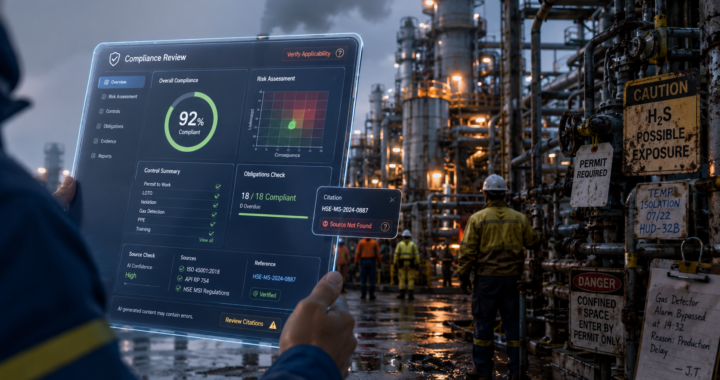
AI excels at producing confident, well-structured, authoritative-looking outputs. HSSE problems are rarely clean, linear, or fully certain. That gap is where people get hurt.
There is something seductive about a clean answer.
A well-formatted risk assessment. A neatly structured legal register. A concise incident investigation report with clear contributing factors and actionable corrective measures. These outputs signal competence. They satisfy auditors. They give management the assurance they are looking for. They look, in every visible respect, like the product of serious professional work.
AI produces them in minutes.
That is not, by itself, the problem. The problem is that HSSE practice does not deal in clean problems. It deals in messy ones: complex sites, unpredictable human behaviour, ambiguous regulatory language, incomplete information, competing operational pressures, and the ever-present gap between what procedures say and what actually happens in the field.
The value of a strong HSSE professional has always been the ability to navigate that messiness with sound judgment, not to produce documents that paper over it.
When AI generates clean answers to messy problems, and those answers are accepted without the critical scrutiny they require, the result is not improved HSSE performance. It is the appearance of it. That is often more dangerous than acknowledged ignorance, because it removes the discomfort that drives people to look harder.
In the previous post, I argued that accountability does not disappear when AI is used in HSSE practice. This post turns to the practical reason that matters: AI can be wrong in ways that are difficult to see.
A poor human assessment often looks poor. It is incomplete, vague, or obviously underdeveloped. A poor AI-generated assessment may look complete, structured, and professionally written. The weakness is not always visible in the form. It is often hidden in the substance.
Hallucination: when the wrong answer looks sourced
In AI, hallucination refers to a system generating information that is factually incorrect but presented with complete confidence. In general conversation, this is an inconvenience. In HSSE compliance practice, it is a serious risk.
AI systems – particularly general-purpose large language models not specifically trained and validated against current regulatory databases – can generate regulatory citations that do not exist. Specific clause numbers. Regulation titles. Issuing authorities. Effective dates. All fabricated, yet presented in the same format and tone as accurate information, with no obvious flag, qualification, or acknowledgement of uncertainty.
Consider the implications for a legal register. An HSSE team using an AI tool to identify applicable regulatory requirements across multiple GCC jurisdictions may receive a document that looks comprehensive, is professionally structured, and contains obligations that were never legislated. The team reviews it, finds nothing obviously wrong, and proceeds. The audit passes. The management system is certified. The gap – invisible, because the fabricated or incorrect requirement has occupied the space where a proper legal interpretation should have been – remains undetected until something goes wrong.
This is not a theoretical concern. It is a predictable consequence of using tools that were not designed for jurisdiction-specific regulatory compliance in contexts that require exactly that. The hallucination problem is not solved by prompt discipline alone. It is addressed by using tools built on validated regulatory databases, expert review, source traceability, and explicit acknowledgement of what the tool does and does not cover.
Overconfidence: the answer that does not know what it does not know
Related to hallucination, but distinct from it, is the overconfidence problem. AI does not know what it does not know– and unless specifically designed to surface uncertainty, it does not behave as though it might.
An experienced HSSE professional reviewing a risk assessment will flag uncertainty. They will note where site conditions are unclear, where the adequacy of a control depends on information they do not have, where a regulatory interpretation is arguable rather than settled, and where local enforcement expectations may affect the practical answer.
That professional uncertainty is not a weakness. It is the signal that tells the organisation where it needs to look harder, verify more carefully, and apply more expert judgment.
Generic AI outputs often provide no reliable signal of uncertainty unless the system has been specifically designed to surface source limitations, confidence levels, assumptions, and gaps in the underlying information. A risk assessment generated by an AI tool may present its outputs with the same confidence regardless of whether the input information is comprehensive or partial, whether the regulatory framework is well-established or recently changed, whether the site conditions described are typical or unusual. The output looks the same either way.
This matters particularly in the GCC context, where regulatory frameworks across multiple jurisdictions are actively evolving, where the gap between formally published requirements and practical enforcement expectations can be significant, and where site conditions – from extreme heat and multi-national workforces to complex contractor structures – introduce variables that no general-purpose AI has been trained to reason about reliably.
The overconfident AI output does not tell you where to look harder. It tells you everything is covered. That is, in many respects, the worst possible message to receive when it is not true.
Dumbing down: precision lost in translation
There is a subtler failure mode that receives less attention than hallucination but may be more pervasive.
AI tools, particularly when prompted to make regulatory content accessible, have a tendency to simplify in ways that lose critical precision. A regulatory requirement that contains thresholds, definitions, exceptions, or conditional obligations may be rendered as a general principle that sounds correct but omits the detail on which compliance actually depends.
“Employers must ensure adequate ventilation in confined spaces” is not wrong. But it may not accurately reflect the requirement. For instance, the requirement may specify what “adequate” means, when confined space classification applies, what monitoring is required, what atmospheric conditions trigger additional controls, and what competency requirements apply to the people conducting the assessment.
In regulatory compliance, the difficult question is rarely only “what does the rule say?” It is whether the rule applies to this activity, in this jurisdiction, under these facts, with these thresholds, exemptions, definitions, and enforcement expectations.
In HSSE practice, precision is not an optional detail; it is part of effective control. Thresholds exist because they define when risk becomes unacceptable or when a legal duty is triggered. Exceptions define the boundaries of applicability. Conditions determine what controls are required. Definitions decide whether a duty applies at all. Losing that precision in translation is not a minor editing issue – it is a compliance failure in waiting.
There is also a longer-term concern. As AI-generated summaries, commentary, guidance documents, and articles become more common, organisations need to be increasingly careful about the quality of the information their tools are drawing from. If a system is trained or grounded on simplified, recycled, outdated, or unvalidated material, its outputs will reflect those weaknesses.
This is why source integrity matters. A general-purpose AI model drawing on broad internet content carries a different risk profile from a domain-specific tool grounded in curated, expert-validated, and regularly updated regulatory material. For HSSE compliance, that distinction is not technical trivia. It is central to whether the output can be trusted.
That distinction – between AI trained on everything and AI grounded in the right things, by the right people, for the right purpose – is one of the most important technical and governance decisions an organisation makes when selecting AI tools for HSSE compliance functions. Everything else follows from it.
False authority: the document that looks right
Taken together – hallucination, overconfidence, and imprecision – these failure modes produce what might be called the false authority problem.
AI-generated HSSE documents look authoritative. They are formatted correctly, written in appropriate professional language, structured to meet recognised standards, and produced with a consistency that individual practitioners rarely achieve across a large volume of work. For anyone reviewing them without deep subject matter expertise, there may be no visible signal that something is wrong.
This creates a systemic risk that is qualitatively different from the risks introduced by poor human work. When a less-experienced HSSE professional produces a weak risk assessment, the weakness is often visible: incomplete sections, vague language, missing controls, acknowledged gaps. A reviewer with expertise can identify and correct it.
When an AI tool produces a weak risk assessment, it may still look complete, confident, and well-structured. The weakness is in the substance, not the form – and catching it requires the kind of deep expertise that the AI output is most likely to be used as a substitute for.
The organisations most at risk are not those whose HSSE professionals are using AI and know it. They are those where AI outputs are being accepted into compliance workflows by teams who do not have the expertise to evaluate them critically – and where the clean, authoritative appearance of the output is being mistaken for quality.
The question every organisation needs to answer
Before the next post in this series turns to how AI is already being used in HSSE practice, there is one question every organisation currently using or considering AI tools in its compliance functions needs to answer honestly.
If an AI-generated output in your HSSE system contained a hallucinated regulatory requirement, an overconfident risk assessment, or a simplified control measure that omitted a critical threshold, would your current review process catch it?
If the answer is yes, with confidence, your governance may be in reasonable shape. If the answer is uncertain, or if the honest answer is no, that is the gap that needs to be closed before AI is embedded any further into your compliance workflow.
Clean answers to messy problems are appealing precisely because HSSE work is hard, complex, and relentless. But the appeal of the clean answer is not a reason to accept it uncritically. It is a reason to look harder.

- The Leak Nobody Noticed - October 19, 2026
- When Four Lines of Defence Become One - October 15, 2026
- The Fluency Trap - October 15, 2026