Most HSE compliance systems work well under normal conditions.
- Legal obligations are identified.
- Actions are assigned.
- Audits are completed.
- Reports are prepared.
But security-related events rarely happen under normal conditions.
And it is during those moments that the limitations of compliance systems become visible.
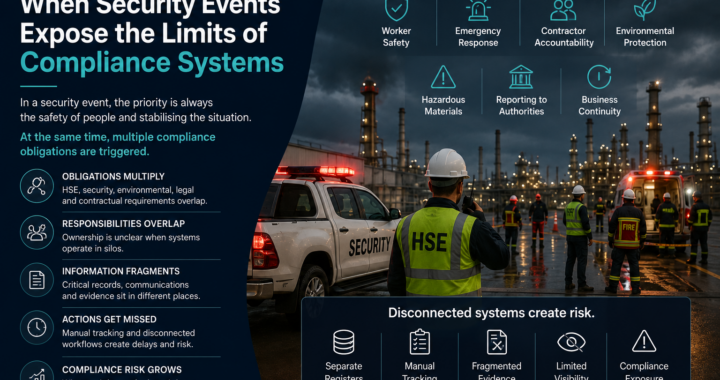
A single incident can trigger multiple obligations at once.
When the Situation Changes
Imagine a project site affected by a security event.
Access is restricted.
Movement is disrupted.
There may be uncertainty around:
- Worker safety
- Site conditions
- Contractor accountability
- Hazardous materials
- Emergency response
- Communication with authorities
- Business continuity
In those moments, the immediate priority is always the safety of people and stabilising the situation.
But alongside the operational response, compliance obligations are also being triggered.
And those obligations may need to be addressed at the same time.
The Questions Start Immediately
Once an incident occurs, organisations may need to answer critical questions very quickly:
- Which legal requirements are triggered?
- Which HSE obligations apply?
- Which security obligations apply?
- Who owns the response?
- Which authorities need to be notified?
- What evidence must be collected?
- What actions need to be tracked?
- How will compliance be demonstrated later?
This is where many organisations begin to struggle.
Not because they lack procedures.
But because procedures, obligations, records, and responsibilities are often managed separately.
Where Systems Begin to Break
In practice:
- HSE requirements may sit in one register
- Security procedures may sit elsewhere
- Incident records may be maintained separately
- Actions may be tracked manually
- Dashboards may not show the full picture
Under pressure, those gaps become visible very quickly.
The Pressure on Smaller Organisations
In smaller organisations, the challenge can be even greater.
There may be no dedicated security department or specialist security team.
In those cases, the HSE manager is often expected to manage:
- Worker safety
- Emergency response
- Regulatory reporting
- Contractor coordination
- Security-related obligations
All at the same time.
That creates risk.
Not only operational risk, but compliance risk.
What Organisations Need
This is why organisations increasingly need more than separate registers and disconnected procedures.
They need a structured way to:
- Identify HSE and security-related legal obligations
- Understand where those obligations overlap
- Audit compliance status
- Assign and track actions
- Maintain evidence and traceability
- View status and progress through dashboards
- Support coordinated response under pressure
Security compliance is no longer separate from HSE.
In many cases, it is directly connected.
And when an event happens, that connection needs to be visible, structured, and manageable.
Join the Discussion – 19 May Webinar
We’ll be discussing these challenges in more detail during our webinar on 19 May:
When Security Becomes an HSE Issue: Managing Compliance Across MENA
Including:
- How HSE compliance is evolving across MENA
- How security-related scenarios create additional obligations
- Where HSE and security requirements overlap
- How to manage both within a structured framework
- How to prepare for audits (including ISO)
- How to track compliance using registers, audits, dashboards, and action plans
👉 Register here: Register for the 19 May Webinar

- Confused About Heat Stress and the GCC Midday Work Ban? - June 27, 2026
- The HSSE Professionals Who Shape AI Will Define the Next Decade - June 19, 2026
- What Responsible AI-Assisted HSSE Compliance Looks Like in Practice - June 16, 2026