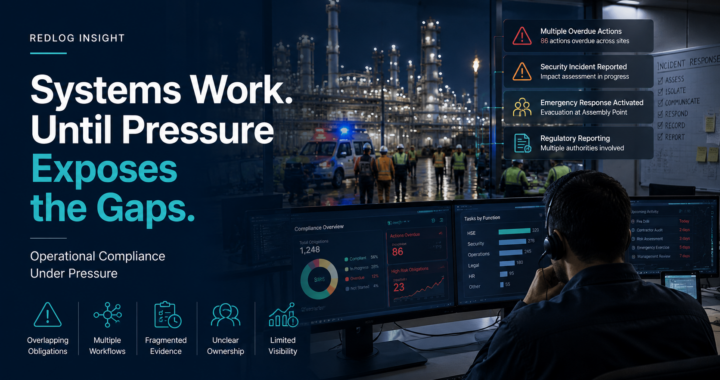
Over the last few posts, I’ve discussed how compliance management evolves:
- From spreadsheets to systems
- From legal registers to operational frameworks
- From isolated HSE obligations to overlapping responsibilities involving security, emergency response, and business continuity
But even when organisations invest in compliance systems, another problem often emerges.
The system itself may still not be designed for the level of operational complexity it is expected to manage.
When Systems Are Built Around Structure—Not Operations
Many compliance systems are effective at managing structured, predictable obligations.
They can:
- Store legal requirements
- Assign ownership
- Track actions
- Maintain records
- Support audits
Under normal operating conditions, this works well.
The challenge appears when obligations begin to cut across multiple domains at the same time.
What Changes Under Pressure
A security-related event, operational disruption, or regional escalation rarely affects only one function.
It may simultaneously involve:
- HSE obligations
- Security procedures
- Emergency response
- Contractor management
- Business continuity
- Workforce communication
- Regulatory reporting
- Environmental controls
At that point, compliance becomes dynamic.
The organisation is no longer managing isolated requirements.
It is managing interconnected obligations under operational pressure.
Where Existing Systems Begin to Fail
This is where many organisations discover the limits of their existing approach.
- Systems Are Organised by Function
Most systems are structured around separate domains:
- HSE
- Security
- Operations
- Legal
- HR
But real events do not follow organisational boundaries.
As a result, information, actions, and evidence become fragmented.
- Compliance Is Managed in Separate Workflows
Different functions often maintain:
- Separate registers
- Separate audit processes
- Separate reporting structures
- Separate records
This creates duplication, inconsistency, and gaps in visibility.
- The System Tracks Requirements—But Not Coordination
Many systems can record obligations.
Fewer can demonstrate:
- Cross-functional accountability
- Coordinated response
- Real-time operational status
- Integrated evidence
And increasingly, this is what organisations are expected to demonstrate.
- Pressure Exposes Weak Visibility
Under pressure, management needs immediate visibility:
- What obligations are triggered?
- Who is responsible?
- What actions are overdue?
- What evidence exists?
- Which sites are affected?
Many organisations struggle to answer these questions quickly and consistently.
The SME vs Enterprise Reality
This issue affects organisations differently—but the underlying challenge is the same.
In smaller organisations:
- One HSE manager may already be handling multiple responsibilities
- Security-related obligations add further operational pressure
- Manual coordination becomes difficult to sustain
In larger organisations:
- Different systems may exist across teams or regions
- Sites may operate inconsistently
- Visibility across the organisation becomes fragmented
The scale changes.
The coordination challenge does not.
Why This Matters Increasingly Across MENA and the GCC
Across the MENA region, and particularly within the GCC, organisations are operating in a rapidly evolving regulatory and operational environment.
This includes:
- Expanding HSE obligations
- Increasing audit expectations
- Greater emphasis on accountability and evidence
- New security-related regulatory domains
- More pressure around emergency preparedness and business continuity
In that environment, compliance can no longer function as a collection of disconnected processes.
It needs to operate as a coordinated framework.
What Organisations Are Really Looking For
Increasingly, organisations are not simply looking for:
- A legal register
- An audit checklist
- A document repository
They are looking for:
- Visibility
- Coordination
- Accountability
- Traceability
- Structured evidence
- Operational control
In other words:
Not just compliance documentation.
Operational compliance management.
Where the Industry Is Moving
This is where the conversation around compliance is beginning to change.
The focus is moving from:
- Maintaining registers
→ to managing obligations operationally - Recording actions
→ to demonstrating control - Isolated compliance domains
→ to integrated governance frameworks
This applies not only to HSE, but increasingly to:
- Security
- Cybersecurity
- Data protection
- Business continuity
- Supply chain resilience
- Emerging technology governance
What Comes Next
As organisations move toward more integrated approaches, another challenge emerges.
How do you structure all of this in a practical, auditable way—without creating even more complexity?
That is where legal registers, auditing frameworks, dashboards, and action plans begin to work together as part of a larger compliance ecosystem.
I’ll explore that in the next post.

- Confused About Heat Stress and the GCC Midday Work Ban? - June 27, 2026
- The HSSE Professionals Who Shape AI Will Define the Next Decade - June 19, 2026
- What Responsible AI-Assisted HSSE Compliance Looks Like in Practice - June 16, 2026