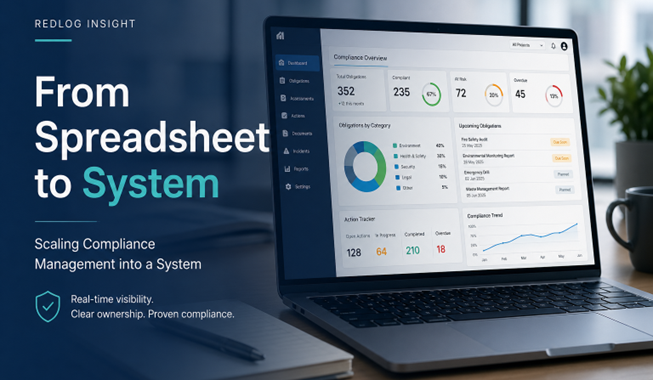
Over the last three decades working on HSE projects across the Middle East, particularly in the GCC, I have seen compliance management evolve in very practical ways.
In the early stages of most projects, compliance is typically managed through spreadsheets. And to be clear, that approach works, at least initially.
We have developed and implemented many Excel-based compliance registers ourselves (and we still do). They are flexible, quick to deploy, and can be tailored to specific regulatory environments, whether that is in Saudi Arabia, the UAE, or elsewhere in the region.
But there comes a point where spreadsheets stop being effective.
And that point is usually not driven by technology. Rather, it is driven by scale and complexity.
When Compliance Becomes Operational
As projects grow, particularly across multiple sites or contractors, compliance management stops being a documentation exercise and becomes an operational challenge.
You start to see the same issues emerge:
• Multiple versions of the same file circulating across teams
• No clear ownership of compliance obligations
• Manual follow-ups to track actions and deadlines
• Limited visibility across sites or business units
• Increasing pressure from audits and regulatory reviews
At that stage, the problem is no longer the spreadsheet itself – it is what the spreadsheet is being asked to do.
Compliance is no longer static information. It is a live, operational process.
The Reality on the Ground
On projects in the region, compliance requirements can quickly expand to include:
• Environmental obligations
• Health and safety requirements
• Site-specific regulatory conditions
• Contractor compliance tracking
• Increasingly, elements of security
Trying to manage all of this through a single spreadsheet, or even multiple spreadsheets, becomes difficult to sustain.
In many cases, teams end up spending more time maintaining the compliance register than actually managing compliance risk.
The Tipping Point
From experience, there are some clear signals that the spreadsheet approach is reaching its limits:
• The number of compliance obligations exceeds what can be easily tracked manually
• Multiple stakeholders are responsible for updates
• Audit requirements become more frequent and more detailed
• Management requires consolidated reporting across sites
• Deadlines and actions start to slip – not because of lack of effort, but because of lack of visibility
• Regulatory requirements are rapidly evolving, creating challenges to maintain updated spreadsheets across multiple users and sites
This is the point where a shift is needed.
From Document to System
What becomes clear at this stage is that compliance cannot be managed effectively as a document.
It needs to be managed as a system.
That means:
• A centralized and structured compliance register
• Clear ownership of each obligation
• Automated tracking of deadlines and actions
• Real-time visibility across projects or sites
• A reliable audit trail of what has been done, and when
In other words, moving from recording compliance to managing compliance.
A Natural Evolution
This transition is not about replacing spreadsheets for the sake of technology.
It is about recognising that as projects scale, the underlying approach to compliance needs to evolve.
In our own work, this realisation came from practical experience: working with clients, managing complex regulatory environments, and seeing first-hand where traditional approaches begin to break down.
What Comes Next
As compliance systems evolve, another challenge begins to emerge.
The Iran conflict has made one thing clear for organizations operating in the GCC: security and emergency preparedness can no longer remain a paper exercise.
Many organizations have emergency response plans, crisis procedures, evacuation protocols, and security escalation processes in place. The issue is not whether these documents exist. The issue is whether they are tested, integrated, assigned to real owners, and capable of being activated under pressure.
In the current GCC operating environment, regional disruption can quickly affect workforce movement, site access, supply chains, emergency response, and duty of care. That means compliance is no longer about having the right plan on file. It is about being able to demonstrate that the plan works in practice.
Recent regional developments have highlighted duty-of-care pressure, workforce disruption, business continuity impacts, and the need to strengthen security, emergency response, and governance frameworks.
That overlap introduces a new level of complexity, which many existing approaches are not designed to handle.
That is where the conversation moves next, and I will be discussing this more in future posts.

- The Leak Nobody Noticed - October 19, 2026
- When Four Lines of Defence Become One - October 15, 2026
- The Fluency Trap - October 15, 2026