In the previous posts, I explored how compliance requirements are expanding, how responsibilities overlap across HSE, security, and operations, and why even well-structured systems begin to struggle under pressure.
At this point, the question is no longer whether organisations have compliance systems.
Most do.
The question is whether those systems are designed for the way compliance now operates.
A Shift in How Compliance Happens
Traditionally, compliance has been managed as a structured, periodic activity:
- Identify legal requirements
- Assign responsibilities
- Track actions
- Review periodically
- Prepare for audits
This approach works when obligations are:
- Clearly defined
- Function-specific
- Relatively stable
But increasingly, compliance is being triggered by events.
From Static Obligations to Event-Driven Compliance
In many operating environments, particularly across the Middle East, compliance is no longer only about maintaining a register.
It is about responding to real-world situations.
A single event — such as a security incident — can trigger:
- HSE obligations
- Security requirements
- Workforce protection measures
- Communication protocols
- Reporting to multiple authorities
- Business continuity actions
These are not isolated tasks.
They are interconnected.
And they need to be managed as such.
Why This Matters
When compliance is event-driven:
- Actions must be coordinated across functions
- Information must be shared in real time
- Responsibilities must be clear under pressure
- Evidence must be captured consistently
- Decisions must be traceable
This is difficult to achieve when systems operate independently.
The Limits of Traditional Approaches
Traditional compliance systems are designed to:
- Track obligations
- Assign ownership
- Monitor completion
They are not always designed to:
- Link actions across different functions
- Align multiple workflows triggered by a single event
- Provide a unified operational view
- Support coordinated response in real time
This is where the gap becomes visible.
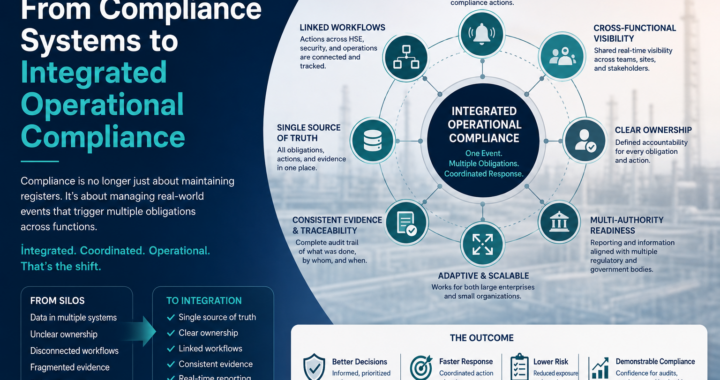
What an Integrated Approach Looks Like
An integrated compliance approach is not about replacing existing functions.
It is about connecting them.
In practice, this means:
- A Single Source of Truth
All obligations — whether HSE, security, or operational — are structured within a unified framework.
- Cross-Functional Visibility
Teams can see:
- What actions are in progress
- Who is responsible
- What has been completed
- What remains outstanding
Across functions and locations.
- Linked Workflows
Actions triggered by an event are not managed separately.
They are connected:
- HSE actions
- Security responses
- Operational decisions
All tracked within a coordinated workflow.
- Consistent Evidence and Traceability
Documentation, records, and decisions are captured in a consistent way, regardless of which function is involved.
This supports:
- Audit readiness
- Regulatory reporting
- Internal review
- Adaptability Across Organisation Size
In larger organisations, this supports coordination across teams.
In smaller organisations, it provides structure where one function — often HSE — is responsible for managing multiple domains.
From Systems to Operational Capability
This is the key shift.
Compliance is no longer only about having a system.
It is about having an operational capability.
One that can:
- Respond to events
- Coordinate across functions
- Maintain visibility
- Demonstrate compliance in real time
What Comes Next
As organisations begin to recognise this shift, the focus turns to practical implementation.
How do you move from separate systems and processes to a more integrated approach?
What does this look like in practice?
And how can it be achieved without disrupting existing operations?
We’ll be discussing these questions in more detail in an upcoming post.

- Confused About Heat Stress and the GCC Midday Work Ban? - June 27, 2026
- The HSSE Professionals Who Shape AI Will Define the Next Decade - June 19, 2026
- What Responsible AI-Assisted HSSE Compliance Looks Like in Practice - June 16, 2026