AI can enhance HSE documentation’s appearance but may reduce the skills necessary for meaningful analysis. Professionals must remain engaged in reasoning to prevent deskilling, as reliance on polished outputs can diminish important observational and interpretive abilities. AI’s effectiveness necessitates that human competence in reviewing and executing tasks is upheld.
Tag Archives: EHS
The Competent HSE Professional, Amplified
AI can make HSE professionals markedly better or quietly worse, depending on how it is used. In the first part of a new series, Randall Shaw makes the positive case: used as a sparring partner rather than a substitute, AI can sharpen professional judgement, not replace it.
Confused About Heat Stress and the GCC Midday Work Ban?
Across the GCC, the summer midday work ban is the most visible heat-safety rule on site — and the most misunderstood. It’s a floor, not a ceiling. Here’s what heat stress actually is, how the six bans differ across the UAE, Saudi, Qatar, Oman, Kuwait and Bahrain, and what your duty of care still requires once the break ends.
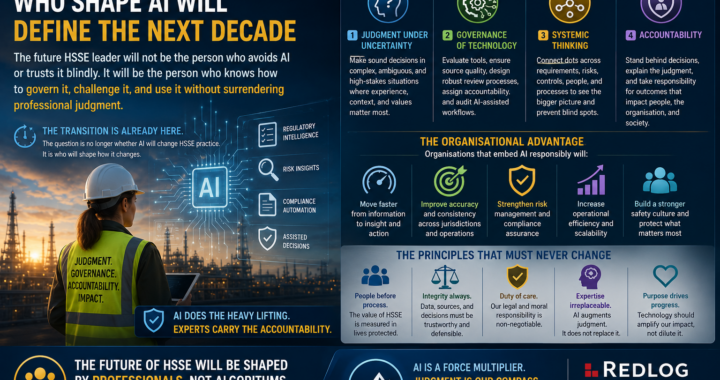
The HSSE Professionals Who Shape AI Will Define the Next Decade
The future HSSE leader will not be the person who avoids AI or trusts it blindly. It will be the professional who knows how to govern it, challenge it, and use it without surrendering judgment. In this final post of the series, I examine why HSSE professionals who shape responsible AI adoption — through governance, systemic thinking, and accountability — will define the next decade of practice.
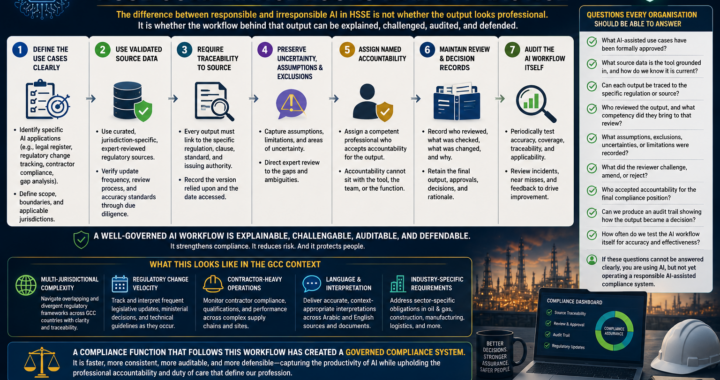
What Responsible AI-Assisted HSSE Compliance Looks Like in Practice
Responsible AI-assisted HSSE compliance is not about polished outputs. It is about whether the workflow behind those outputs can be explained, challenged, audited, and defended. A governed AI compliance system requires clear use cases, validated source data, traceability, documented uncertainty, named accountability, review records, and periodic audit.